Selected Peer-Reviewed Publications
Ringing an Early Alarm Bell: Image-Based Sexual Violence against Political Actors – Dianne Lalonde in Gender-Based Violence in Canadian Politics in the #MeToo Era (University of Toronto Press)
Politically active individuals have been targeted in the non-consensual creation and distribution of intimate content in a phenomenon known as image-based sexual violence (IBSV). In some cases, private sexual images are shared online by a former intimate partner. In other cases, perpetrators take publicly available material to produce fake sexual images and videos through artificial intelligence (known as non-consensual sexual deepfakes).
In order to raise awareness and enhance our understanding of gender-based violence in politics, this chapter uses an intersectional anti-oppression lens to explore IBSV as a tactic to control and intimidate political actors in the Canadian context. It shares how IBSV disproportionately targets women and marginalized groups, in addition to the gendered and intersectional impacts of IBSV in politics. Finally, this chapter makes a case as to why recognizing IBSV is an urgent need in Canadian politics to end violence, empower oppressed groups, and strengthen Canadian democracy.
Click here to access this chapter
Social Inclusion Through Trauma- and Violence-Informed Research: A Focus on Survivors of Violence – Dianne Lalonde, Robert Noromura, Jassamine Tabibi, Linda Baker, and Marika Morris in Handbook of Social Inclusion (Springer)
This chapter includes examples of why trauma and violence are significant considerations for how research is conducted in Canada. A focus on trauma- and violence-informed research goes beyond avoiding the traumatization of participants through insensitive methodologies. It is rooted in respect for, and work with, survivors of trauma and is most often led or co-led with survivors themselves. Trauma- and violence-informed research is appropriate for any population having experienced physical, sexual, psychological, social, or other trauma, such as refugees, frontline responders or others with post-traumatic stress disorder (PTSD), persons from LGBTQ+ communities, Indigenous peoples, racialized populations, and other populations having experienced trauma and/or social exclusion.
Click here to access this chapter
Does Cultural Appropriation Cause Harm? – Dianne Lalonde in Politics, Groups, and Identities
Cultural appropriation is often called a buzzword and dismissed as a concept for serious engagement. Political theory, in particular, has been largely silent about cultural appropriation. Such silence is strange considering that cultural appropriation is clearly linked to key concepts in political theory such as culture, recognition, and redistribution. In this paper, I utilize political theory to advance a harm-based account of cultural appropriation. I argue that there are three potential harms with cultural appropriation: (1) nonrecognition, (2) misrecognition, and (3) exploitation. Discerning whether these harms are present or absent offers a means of placing specific instances of cultural appropriation on a spectrum of harmfulness. I conclude by considering how cultural appropriation, and associated appropriative harms, may be avoided.
Click here to access this article webpage
Click here to download this article
Regret, Shame, and Denials of Women’s Voluntary Sterilization – Dianne Lalonde in Bioethics
Women face extraordinary difficulty in seeking sterilization as physicians routinely deny them the procedure. Physicians defend such denials by citing the possibility of future regret, a well‐studied phenomenon in women’s sterilization literature. Regret is, however, a problematic emotion upon which to deny reproductive freedom as regret is neither satisfactorily defined and measured, nor is it centered in analogous cases regarding men’s decision to undergo sterilization or the decision of women to undergo fertility treatment. Why then is regret such a concern in the voluntary sterilization of women? I argue that regret is centered in women’s voluntary sterilization due to pronatalism or expectations that womanhood means motherhood. Women seeking voluntary sterilization are regarded as a deviant identity that rejects what is taken to be their essential role of motherhood and they are thus seen as vulnerable to regret.
“Regret involves feeling disappointment or remorse over an occurrence or a missed opportunity. It is not an emotion experienced in isolation; it is informed and shaped by our social relations with others. In the case of voluntary sterilization, regret is socially constructed within a discourse where womanhood means motherhood.”
Dissertation
Cultural Appropriation: How Meanings Are Taken, Distorted, and Destroyed – Dianne Lalonde
At its core, cultural appropriation is about meaning. What is at stake when objects or practices are appropriated are the meanings embedded in these objects and practices. When cultural members discuss cultural appropriation, they explain and resist the appropriation by sharing their cultural understandings. Leading accounts of cultural appropriation miss the critical importance of meaning in their focus on sharing or oppression. In comparison, this dissertation develops a critical meaning-making account of cultural appropriation. It starts by identifying how cultures are sites of meaning-making wherein individuals make sense of the world through their cultural understandings. However, these understandings cannot be separated from context and power. Cultural groups have existed over time, but they are not without history, change, or engagement with further cultural groups.
The account of critical meaning-making shared in this dissertation offers an understanding of how cultural groups as sites of meaning-making are situated in the surrounding socio-historical context, power relations, and further sites of identity like racialization, gender, and ability. By centering meaning in cultural appropriation, what is taken through appropriative acts is found to be a specific form of property termed herein as constitutive cultural property. Constitutive property is not like other forms of property that may be easily exchanged and replaced. Rather, it includes those items that are closest to oneself such as family heirlooms and sentimental items. For cultural groups, constitutive cultural property is those central objects and practices that they use to tell their story.
When constitutive cultural property is taken through cultural appropriation, cultural group members are harmed because what is meaningful to them comes to be used by others for their own purposes. For marginalized cultural groups, the loss of their constitutive cultural property threatens to further oppressions they face which erase their identity, stereotype the cultural group, and serve to economically benefit others through the taking of their labour.
Selected Online Resources
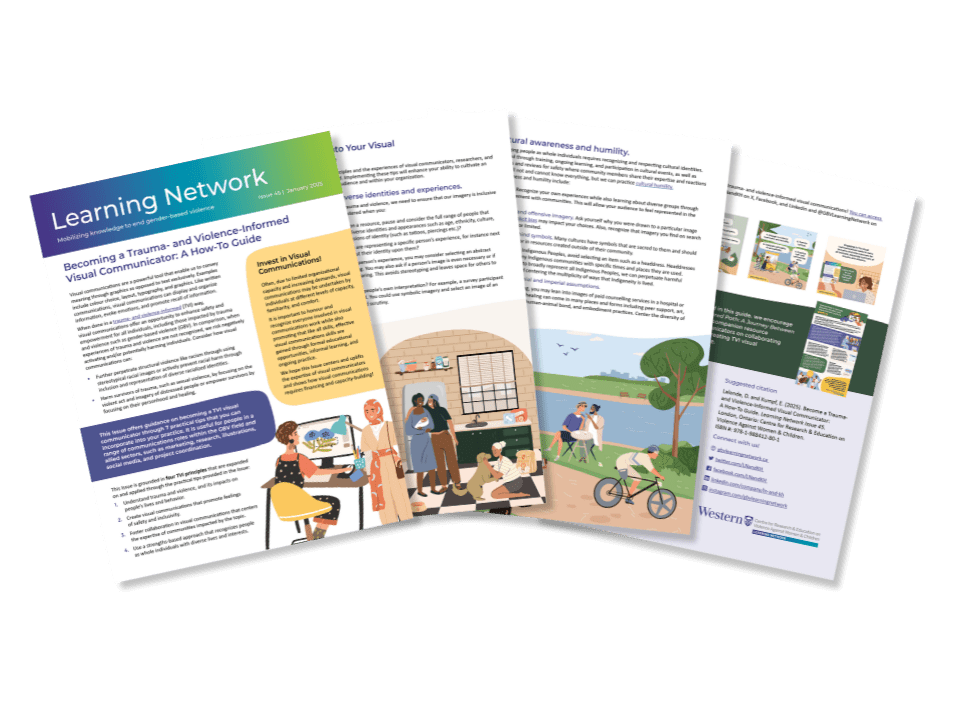
Issue-Based Newsletter
Becoming a Trauma- and Violence-Informed Visual Communicator: A How-To Guide
Dianne Lalonde and Emily Kumpf

Issue-Based Newsletter
Addressing Sexual Violence and Promoting the Sexual Rights of Women Labelled with Intellectual Disabilities
Dianne Lalonde, Bonnie Brayton, Valérie Grand’Maison, and Maggie Lyons-MacFarlane
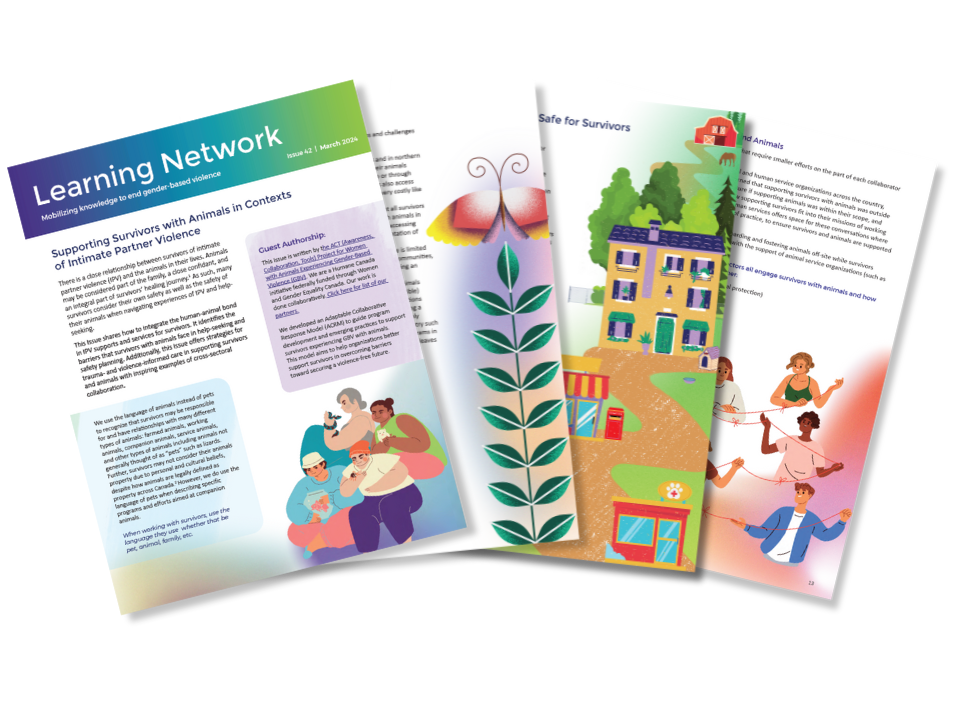
Issue-Based Newsletter
Supporting Survivors with Animals in Contexts of Intimate Partner Violence
Sue O’Neill, Claire Dulude, Jasmine Ferreira, Kathy Duncan, and Dianne Lalonde
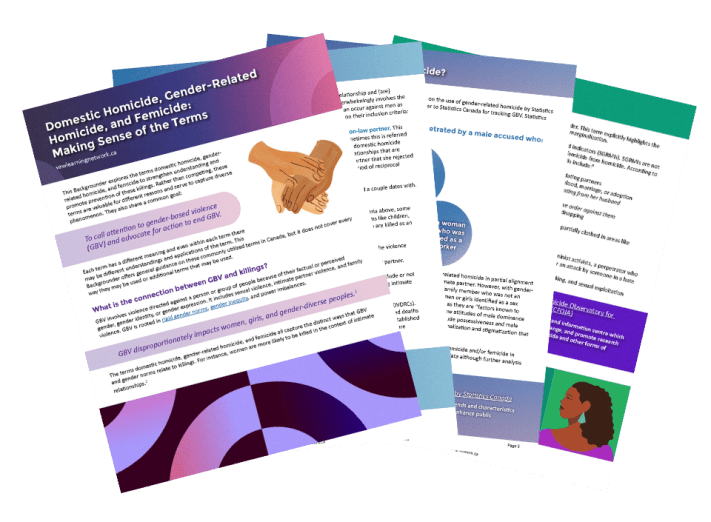
Backgrounder
Domestic Homicide, Gender-Related Homicide, and Femicide: Making Sense of the Terms
Dianne Lalonde
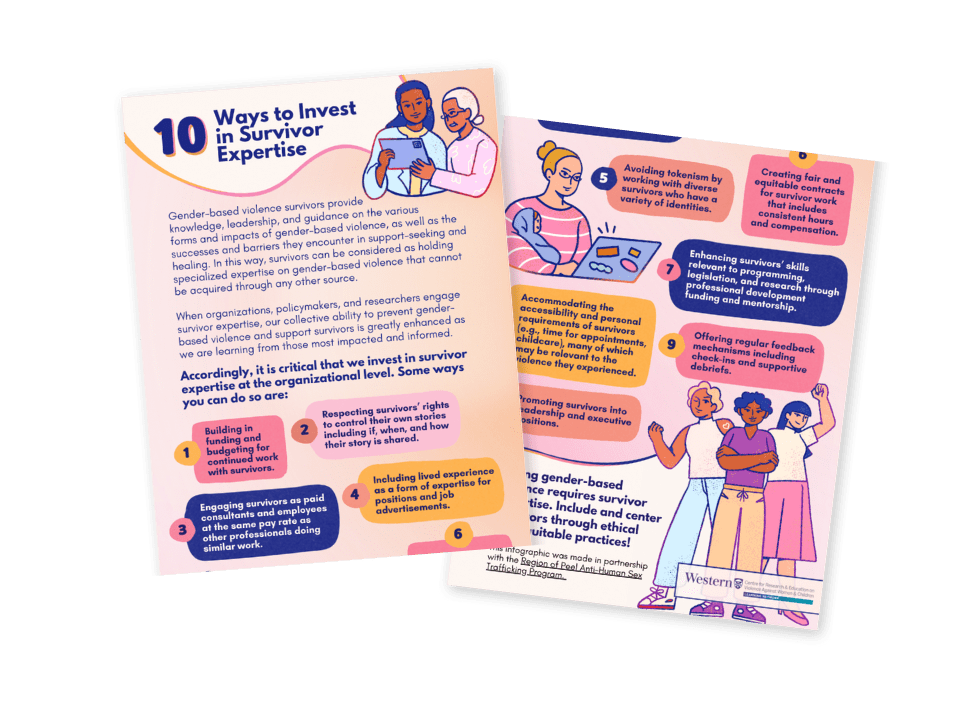
Infographic
10 Ways to Invest in Survivor Expertise
Dianne Lalonde
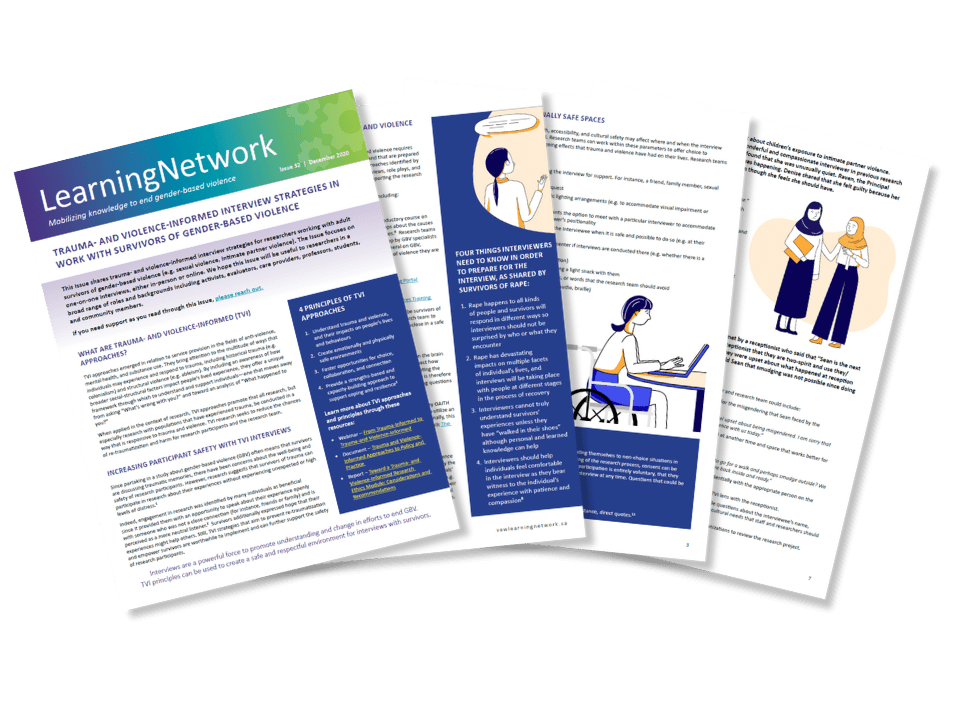
Issue-Based Newsletter
Trauma- and Violence-Informed Interview Strategies in Work with Survivors of Gender-Based Violence
Dianne Lalonde, Linda Baker, Robert Nonomura, and Jassamine Tabibi
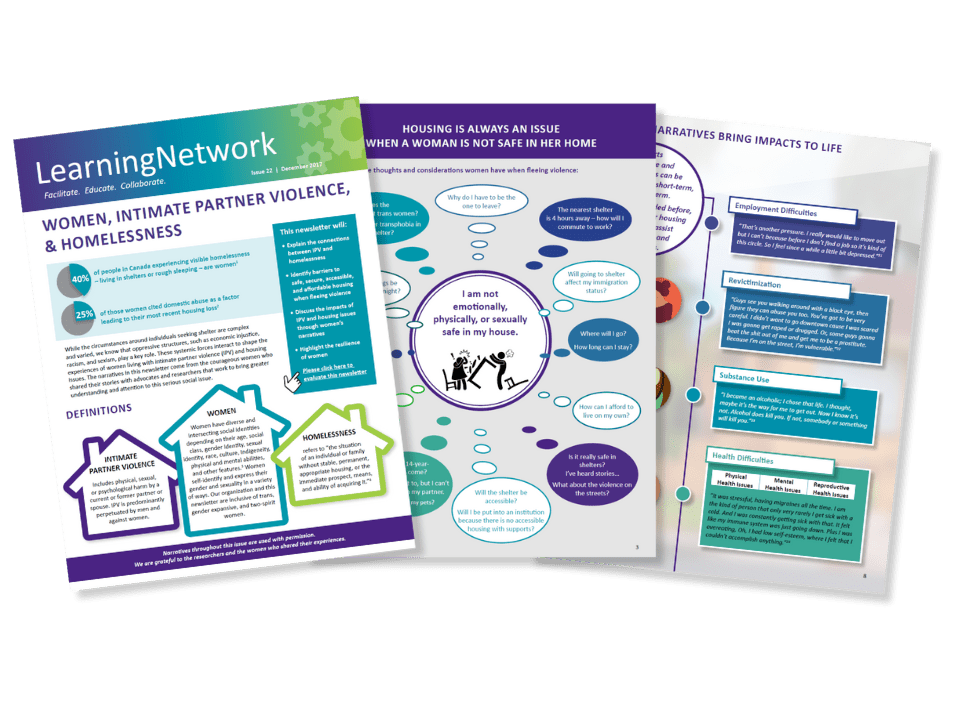
Issue-Based Newsletter
Women, Intimate Partner Violence, and Homelessness
Dianne Lalonde, Linda Baker, and Jassamine Tabibi
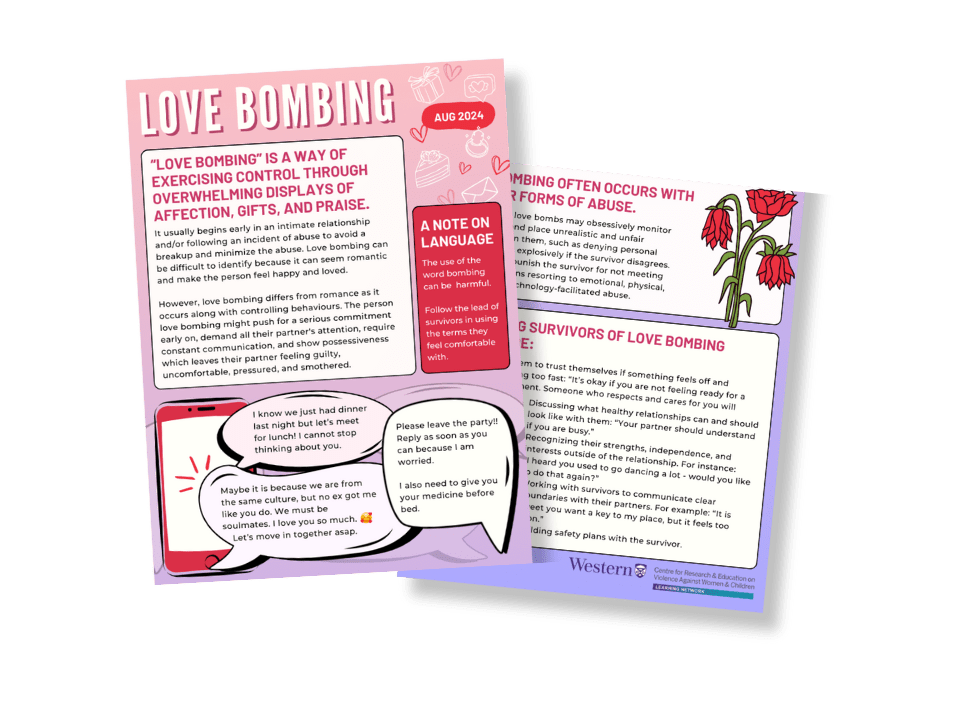
Infographic
Love Bombing
Dianne Lalonde
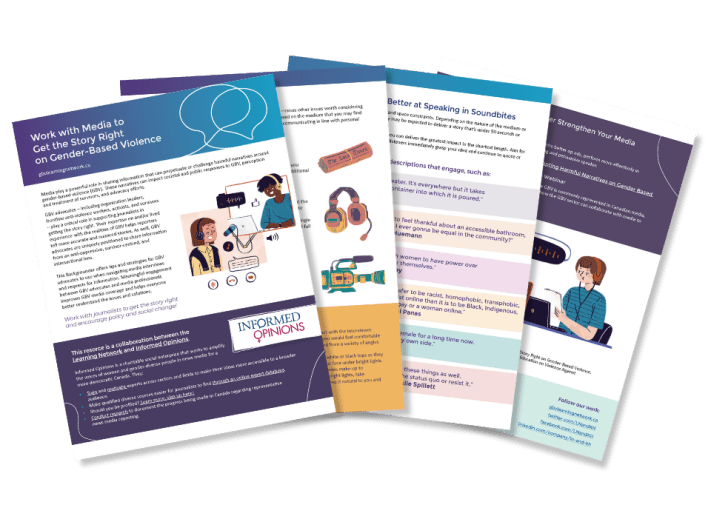
Backgrounder
Work with Media to Get the Story Right on Gender-Based Violence
Shari Graydon, Dianne Lalonde, and Jassamine Tabibi
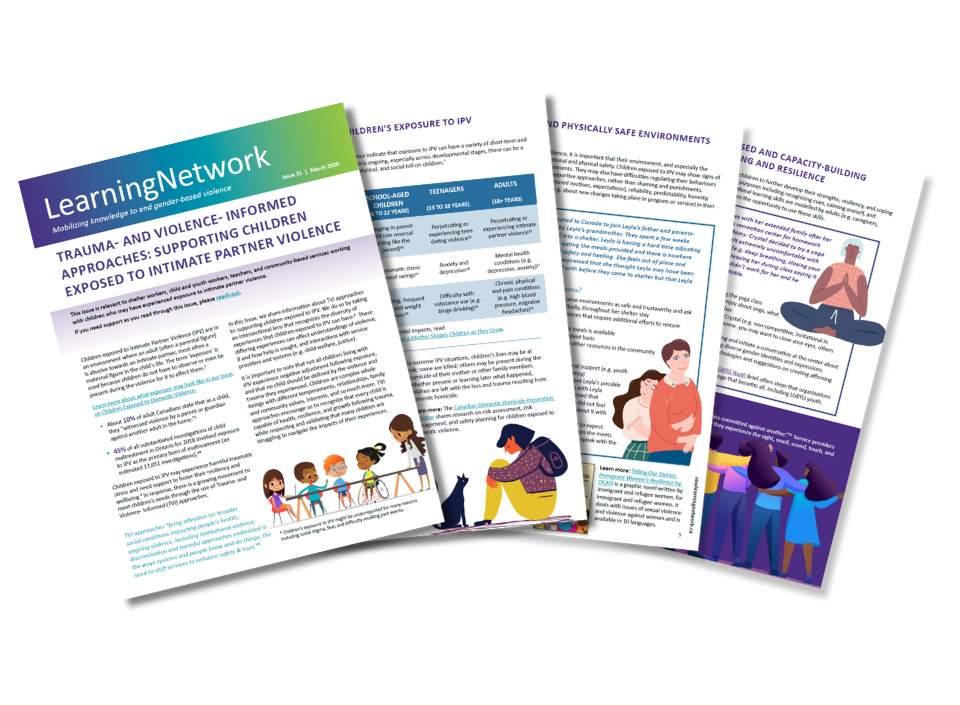
Issue-Based Newsletter
Trauma- and Violence- Informed Approaches: Supporting Children Exposed to Intimate Partner Violence
Dianne Lalonde, Jassamine Tabibi, and Linda Baker
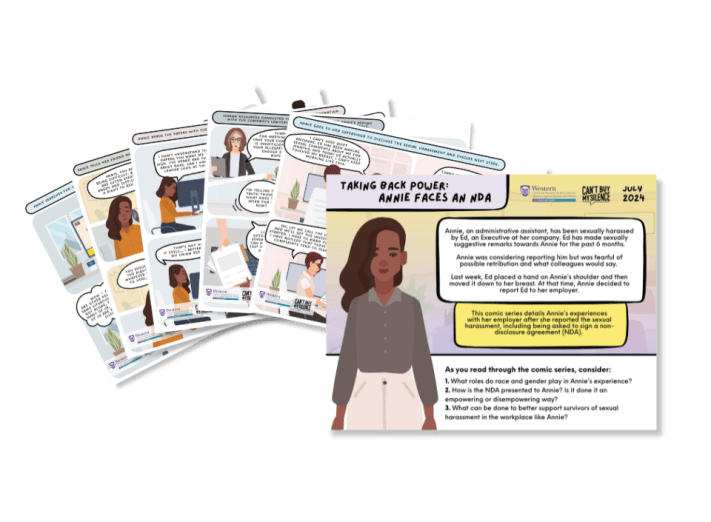
Comic
Taking Back Power: Annie Faces an NDA
Julie Macfarlane, Stacey Buchholzer, Dianne Lalonde, and Emily Kumpf
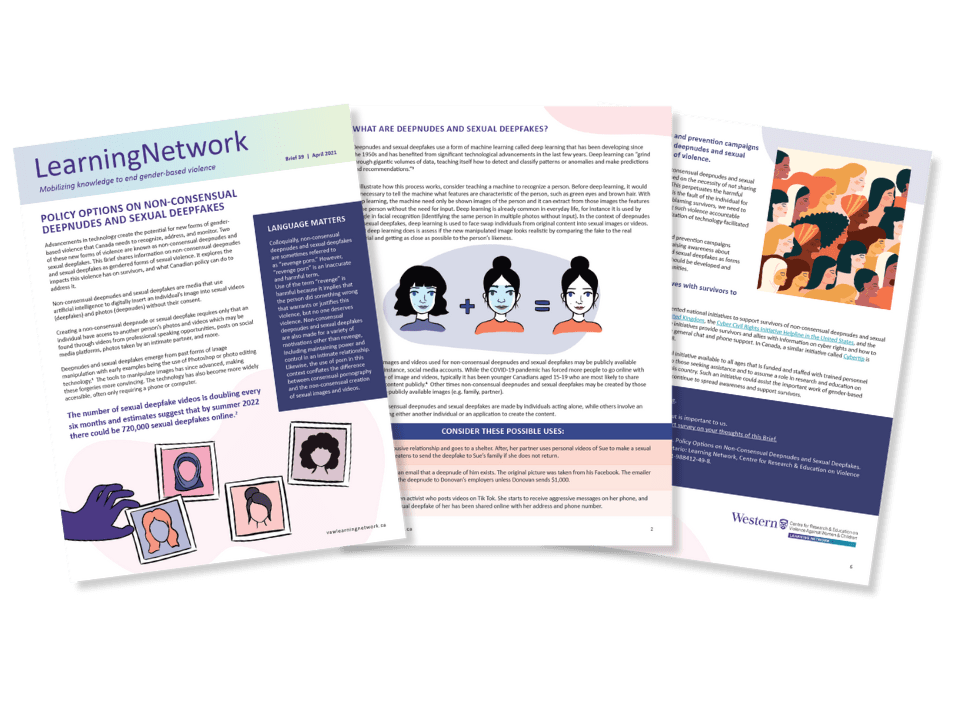
Brief
Policy Options on Non-Consensual Deepnudes and Sexual Deepfakes
Dianne Lalonde
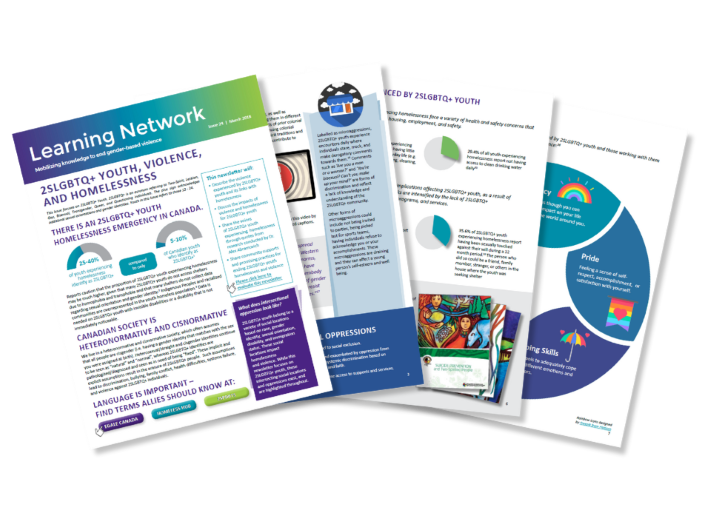
Issue-Based Newsletter
2SLGBTQ+ Youth, Violence, and Homelessness
Dianne Lalonde, Alex Abramovich, Linda Baker, and Jassamine Tabibi
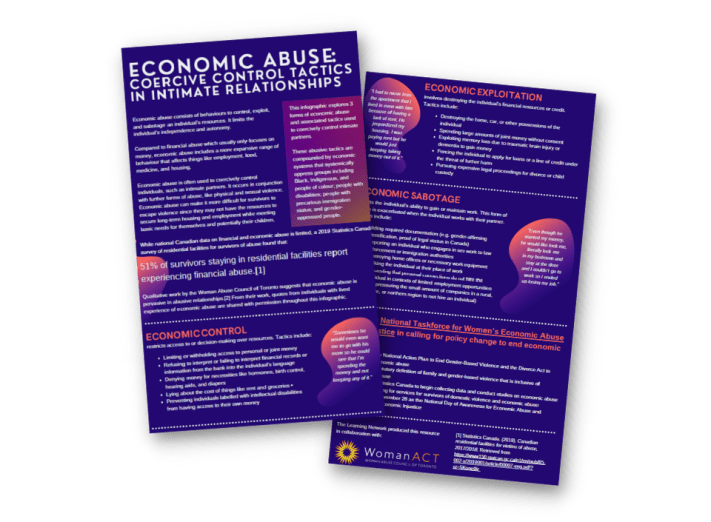
Infographic
Economic Abuse: Coercive Control Tactics in Intimate Relationships
Dianne Lalonde
Selected News Articles
Article: Online harms need a gender-based analysis
I spoke to this article as a witness during a House of Commons’ Standing Committee on Canadian Heritage.
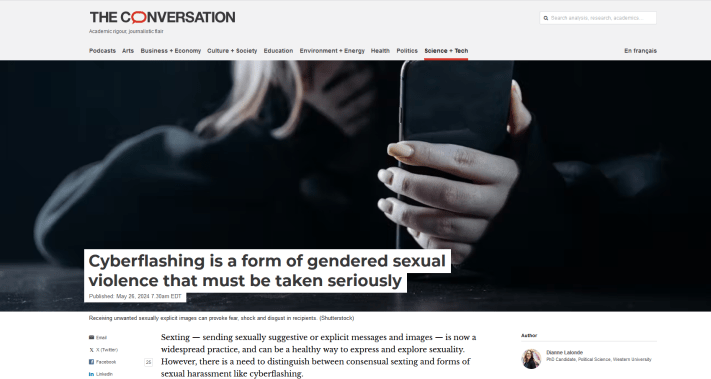
Article: Cyberflashing is a form of gendered sexual violence that must be taken seriously

Article: Canadians should watch out for dumbfakes and deepfakes
This piece was picked up by London Free Press, TechXplore, and The Province. I was also interviewed by BNN Bloomberg about deepfakes.
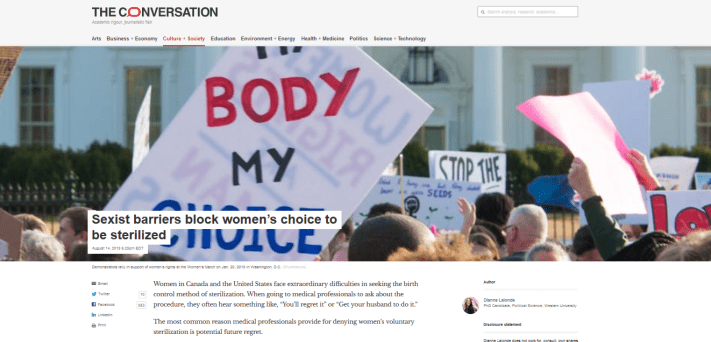
Article: Sexist barriers block women’s choice to be sterilized
This piece was picked up by National Post, The World Economic Forum, and Medical Xpress.
It was informed by my publication Regret, shame, and denials of women’s voluntary sterilization in Bioethics.

Lieutenant Governor’s Visionaries Prize
I was a finalist in the 2017 Lieutenant Governor’s Visionaries Prize administered in partnership with the Walrus Foundation.
My participation was featured in The Chronicle Journal and the Western School for Advanced Studies in the Arts & Humanities Blog.
Video from the event:
 Dianne Lalonde